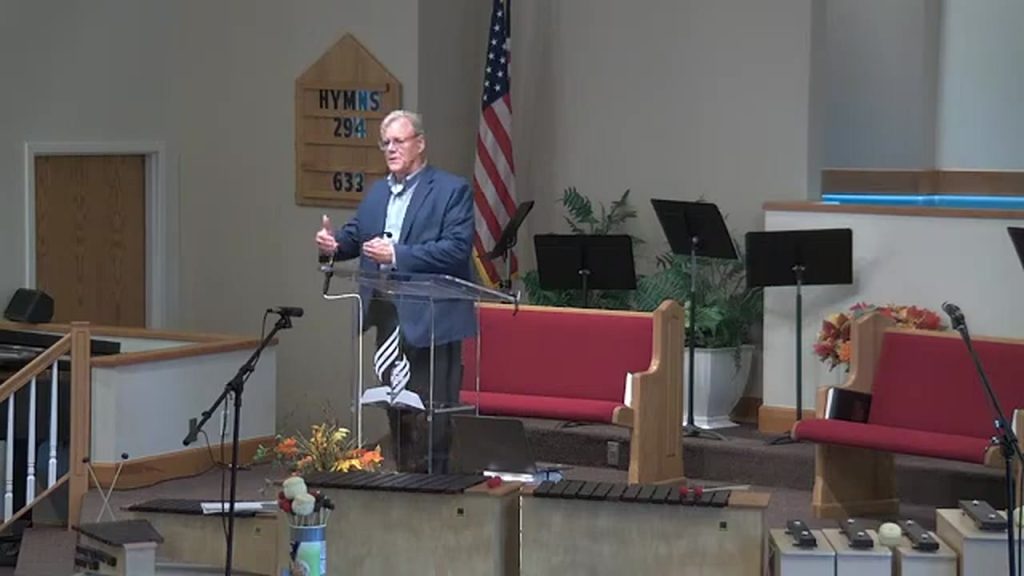
On Sabbath, October 3, 2026, Kevin Michalek returned to the pulpit at the Johnson City Seventh-day Adventist Church, a church he was part of years ago, with a message called “Acting on the Truth.” The sermon is built on one of Jesus’ best-known parables: the rich man and Lazarus in Luke 16.
How a parable works
Kevin began by asking everyone, kids included, to put on their “thinking caps.” A parable, he explained, is different from a narrative. The Greek word starts with para, “beside,” like two railroad tracks running next to each other. Jesus sets two stories side by side, and the point is in the punchline, the last word. Everything else in the story is a prop that leads up to it.
In the story of the persistent widow in Luke 18, the punchline is “When the Son of Man comes, will He find faith on the earth?” In the rich man and Lazarus, it is the answer Abraham gives at the very end:
If they hear not Moses and the prophets, neither will they be persuaded, though one rose from the dead.
Luke 16:31
The rich man, Lazarus and the punchline
A rich man dressed in purple and fine linen lived in luxury every day, while a beggar covered in sores lay at his gate. Kevin pointed out that the rich man is never named, but the poor man is. Lazarus means “God comforts.” After both men die, the rich man begs Abraham to send Lazarus to warn his five brothers. Abraham says they already have Moses and the prophets. Even a man raised from the dead would not change hearts that will not listen.
Kevin’s takeaway: there is an urgency to act on the truth we already know. When we don’t, we slowly lose the capacity to act on it at all. Right starts to look wrong, and what was clear becomes blurry. He noted that even after the resurrection, Matthew 28:17 says “some doubted.” More proof does not help a heart that has already decided.
Hearing without doing
Kevin walked through several verses from James that describe what happens when we take in truth without living it:
- James 1:22: “Be ye doers of the word, and not hearers only, deceiving your own selves.”
- James 1:8: “A double minded man is unstable in all his ways.”
- James 4:17: “To him that knoweth to do good, and doeth it not, to him it is sin.”
The problem, he said, is not a lack of information. We have the Bible, and that is enough. The problem is in the heart and how it receives what God shows it. An open heart is still “in process,” and God patiently keeps bringing things back until they are cleaned up. A closed heart will rationalize almost anything. Knowledge without action, Kevin warned, just makes us “better educated sinners.” But when we do act on the light we have, God gives us more light.
Stepping over Lazarus on the way to church
Kevin pictured the rich man stepping past Lazarus on his way to the synagogue to hear the law and the prophets read, perhaps a passage like Isaiah 58:
Is not this the fast that I have chosen? to loose the bands of wickedness, to undo the heavy burdens, and to let the oppressed go free, and that ye break every yoke? Is it not to deal thy bread to the hungry, and that thou bring the poor that are cast out to thy house?
Isaiah 58:6–7
If the rich man had acted on what he heard, he would have fed and clothed the man at his gate, and found more joy in giving than in hoarding. Instead, Kevin suggested, he talked himself into the idea that it was all too unclear. What exactly are “bands of wickedness”? Where does poverty end and wealth begin? Each time he stepped over Lazarus, it got easier.
Kevin was careful to say this is not only about money, and it is not a sin to be wealthy. Abraham was rich. Paul’s counsel in 1 Timothy 6:17–18 is that the rich be generous and ready to share. He also gave practical advice about helping wisely, for example giving food or a meal certificate rather than cash. The point is to stay in tune with the Spirit, so that when God puts someone in front of us, we respond.
Living the truth, not just knowing it
Most truths of the kingdom, Kevin said, are only really understood when we live them. He can explain the four Greek words for love, but if he is not loving, what does it mean? Our lives are a river, not a pond. They are always moving one direction or the other.
He shared stories of people who acted on what they knew. One was his late friend Bill Liversidge, who prayed to be led to someone who needed to hear from God, turned right instead of left on the way to the airport, and told a homeless young woman that God loved her and knew her situation. Another was an early Anabaptist believer who escaped prison across a frozen lake, then turned back to rescue the guard who fell through the ice, knowing it would cost him his life.
The sanctuary picture
Kevin closed with the sanctuary. In Revelation 11:2, John is told to measure the temple, the altar and the worshipers, but to leave out the outer court. The outer court, he explained, is where we profess and confess our faith. The holy place, with the bread of the Word, the incense of prayer and the light of the Spirit, is where that profession becomes an experience that prepares us to dwell with God. He tied this to Revelation 13, where two different Greek words for “dwell” contrast those who tabernacle with God in heaven (verse 6) with those who settle permanently on the earth (verse 8).
His final verse was Galatians 5:6: faith “worketh by love.” Faith is energized by love. The more we understand God’s love and His character, the greater our faith will be, and the more naturally we will act on the truth we know.
Watch the sermon
The video below starts where Kevin is introduced (about 1 hour 6 minutes into the service). The full service, including the children’s program and music, is on the Johnson City SDA YouTube channel.
More of Kevin’s talks and sermons are on our Videos page.