How do you see the world?
When Asaph, the chief Levite musician under David, wrote Psalm 73, he said in verse 2 that his feet almost slipped, an idiom that speaks of the fact that his anger almost overtook him when he became envious of the proud people and saw the prosperity of the wicked.
To Asaph, unrighteous people have an apparently unpretentious, careless and carefree lifestyle, which according to Asaph has every “appearance” of escaping judgment. In our society we see it all around us, and it can become easier to take sides and begin to judge: us vs. them. I think sometimes Jonah felt that way with the Ninevites. Asaph, like some of us, suffered from a myopic vision problem. We tend to see things from a single focused viewpoint, comparing who we are and our problems with others, and if not held in check we can end up complaining to God about our issues, and ultimately end up blaming God.
In verses 5–8 he sees the rich get richer and have no apparent struggle. Asaph feels that it is worthless to live an upright life in the light of injustice and pride: “Surely in vain I have kept pure motives and maintained a pure lifestyle” (v. 13, NET). Asaph admits that trying to make sense of it only brought him grief and consternation.
An about-face in the sanctuary
But in verses 16 and 17 everything changes. We could say that there is an “about-face” to his thinking regarding this injustice. He says, “I tried to understand this but it was too hard for me to see, until I went in the sanctuary, then I understood their end.”
The sanctuary revealed to Asaph that justice is meted out in God’s own time. But God also created within each person the principle that if we don’t act on truth (what we know through scripture) then we will become self-deceived. God allows the wicked to stand on, as verse 18 states, “slippery places,” חלקה chelqah (khel-kaw’) (deceived). God allowed for their own self-deception unto ruin. In other words, the sanctuary reveals that they will be held accountable for their actions of self-deception. It’s not that they were never given a chance to know, but rather they did not act on the light they had, thus becoming self-deceived; see James 1:22 and John 3:19–21.
In verse 20 Asaph likens the wicked to people “living in a dream,” and then they will wake up in devastation. In verses 21 and 22 he now believes that it would be beneath him to allow himself to be tempted with any further doubting thoughts of God’s injustice. God will make all things right, as Romans 12:19 states: “Vengeance is mine; I will repay, saith the Lord.” Asaph reassures himself and states in verse 23 that he “continually” (tamid = daily) dwells with God. In verse 26 he says that “God is the strength (rock) of my (mind = character),” לבב lebab (lay-bawb’). Therefore, Asaph “daily” makes God the “rock” of his “character.”
Pray instead of judging
He learned that those who faithlessly abandon God, and choose the world rather than His love, fall prey to self-deceived destruction. In the end Asaph felt God is justified, but he felt that God’s way to repay injustice seems to be never soon enough, especially when the righteous suffer. We can also learn that if we continually focus on the injustice, our feet can slip in our Christian walk as well.
Let us remember that the next time we are tempted in our minds to judge, perhaps we can offer up a prayer for that individual instead. After all, the sanctuary will bring justice, and Matthew 5:44, 45 can be fulfilled:
Love your enemies, bless them that curse you, do good to them that hate you, and pray for them which despitefully use you, and persecute you; that you may be the children of your Father who is in the sanctuary.
Matthew 5:44–45
God Bless,
Kevin Michalek
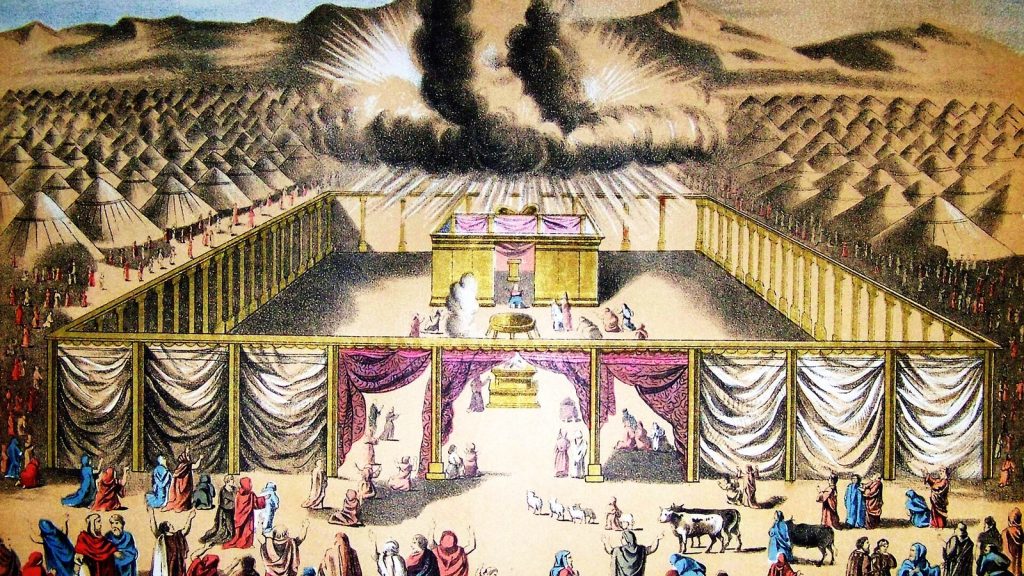
Image: “The Tabernacle in the Wilderness,” illustration from the 1890 Holman Bible, public domain, via Wikimedia Commons.